Thursday, 24 April 2008

research

EXIT
Choreography: Jamie Watton
Director: Charan Goul


The location (the london underground) in this peice is as important as the dance itself, some shots have no dancer oin them at all. Clear narrative, shown by cross cuts.

PULL
Bruce Mclean, David Proud, Ashley Page, Jane Thorburn and Mark Lucas


This discribes itself as a "scultural dance". its about searching for the perfect body. The movements and editing are fosuced around and influenced completely by the props - which make up some of the costumes (huge card hats) and also big boards the dancers transport around like billboards. There are lots of sliding screens and split screens so in the end you dont know whether its the boards moving around or the editing! this is one of the few peices ive seen so far that include text within the dance, almost like headlines. the screen is alos in widescreen format which i think is to remind you of watching films.

MAN IN MOTION
Choreographer: Moniek Merkx
Director: Noud Heerkens
1995


E PUR SI MUOVE
Choreography: Harijono Koeban, Andrea Leine
Director: Peter Delpeut

The entire film is done in one shot, it zooms in and out but stays stationary. Interesting use of blurring - the film starts of completely blurred, you can just see movemet and colour.

CORZAND
Choreogrpher: Clara van Gecol, Angelica Oai
Director:George Bugmans
1993


KADER

madness

Duet
Choreographer: Will Tucket
Director: The Quay Brothers
2000

Tuesday, 22 April 2008

Matthew Bourne on dance made for film

"In my work, I use imagery from my favourite movies t create vivid and familiar pictures but creating dance for camera offers a completely different but equally rewarding challenge.

Dance and television are natural companions but theatrical dance can often appear constrained by a 2-dimensional TV screen. This series [4 Dance] escapes these confines by making the camera the motivation for the choreography. These pieces couldn’t be performed in the theatre.


Some films tell a clear story and place us in a real world with recognisable characters and situations. Others have a less clear narrative but evoke potent emotions and feelings. And some take pleasure in the movement itself and its relationship with the camera and space. Because dance is not a literal art form, its secrets and meanings are revealed gradually - the interpretation often personal and unique to the viewer. You don’t need to be an expert in contemporary dance to enjoy it – far from it. Each film communicates in its own special way.”

MY breif!

I intend to explore the possibilities of combining film and dance to create a final piece that not only documents the dance, but adds to it. I find this relatively new combination of art forms very exciting. I am also interested in the use of sound and music as accompaniment to the visual piece. I’m planning for the final outcome to be a film piece but I want to allow myself a certain amount of freedom to add to this, maybe with photography, print work or even live performance, depending on where the dance takes it!

A dance film is one in which dance and film/video are both integral to the work. This simple definition separates dance films from archival records of stage or site specific dance compositions. The placement and movement of the camera, the lighting, the balance of foreground and background, and the composition within the framing of each shot is considered in the overall choreography. A dance film can take many forms: documentary, dance designed for the camera (cine dance or screen dance), a screen adaptation of a stage work, animation, or kinetic abstraction.


“The structure for a dance for the camera, otherwise known as a cine dance or screen dance, may be driven by a kinetic or visual design concept, poetry or narrative, imagery from reality and/or dreams, traditional or idiosyncratic musical forms. The intention may be to produce what cannot be conceived in a live performance or to stretch and condense a multi-media form. The essential difference between an archival record of a stage work and what we are referring to as a dance film, a dance for the camera, is the involvement of the choreographer in a collaboration with a composer, cinematographer, editor, and a director. The choreographer may also assume all those roles him or herself as well. ” – Dance Films Association

"Dance and Screen have been so inextricably linked since the beginnings of cinema that audiences and even many dance makers almost take them for granted. Perhaps this familiarity contributes to why the dance film ‘genre', in relation to other cinematic endeavour, continues to remain under-developed as a singular creative medium. This immaturity has certainly impoverished the growth potential for a nascent critical language or a coherent democratic means to set in place uncontentious qualitative criteria." - Sandy Strallen, Curator of the LIDFF (London International Dance for Film Festival) 2007

Thursday, 14 February 2008

Explaination of my Idea

Whilst reading lots of things about physchogeography, I realised how much it ties in with Parkour. A traceur has to respond and adapt thier movements to thier enviroment, being competely aware of thier surroundings.

"Parkour is an activity with the aim of moving from one point to another as efficiently and quickly as possible, using principally the abilities of the human body. It is meant to help one overcome obstacles, which can be anything in the surrounding environment — from branches and rocks to rails and concrete walls — and can be practiced in both rural and urban areas."

I thought it wuold be interesting if I could make the urban enviroment respond to the traceur - as well as te traceur responding to the enviroment. I'm going to make a short video tracking a run, where the surrondings are changing and responding to the movemets of the traceur.

interesting quotes

"Reality, as it evolves, sweeps me with it. I am struck by everything and, though not everything strikes me in the same wa, i am always struck by the same basic contradiction; although i can always see how beuatiful anything could be if oly i could change it, in practically every case ther is noghting i can really do. Everything is changed into something else in my imagination, then the dead wieght of things changes it back into what it was in the first place. A bridge between imagination and reality must be biult."

The Revolution of Everyday Life, Roaul Vaneigem, 1967


About psychogeography- takes pedestrians off thier predictable paths and jolts them into a new awareness of the urban landscape.


"All space is occupied by the enemy. We are living under a permanent curfew. Not just the cops – the geometry."

Manifesto of Unitary Urbanism, Roaul Vaneigem


"-understand their location, and therefore thier existance" -?!


"architectural performance."


"pedestrian exploration of the urban and suburban landscape."


The following quotes are from Formulary for a New Urbanism, Ivan Chtcheglov, 1963;


"Our imaginations, haunted by the old archetypes, have remained far behind the sophistication of the machines."


"Closed landscapes"

"integrate modern science into new myths remain inadequate"

"Darkness and obscurity are banished by artificial lighting"

"Architecture is the simplest means of articulating time and space, of modulating reality and engendering dreams."

"Architectural complexes will be modifiable. Their appearance will change totally or partially in accordance with the will of their inhabitants"

"This need for total creation has always been intimately associated with the need to play with architecture, time and space."

"the absence of the object becomes a presence one can feel." - of de chiricos work

"The changing of landscapes from one hour to the next will result in total disorientation."


The following quotes are from Theory of the Dérive, Guy-Ernest Debord;


"In a dérive, 1 or more persons drop usual motives for movement and action and let themselves be drawn by the attractions of the terrain and the encounters they find there."


"When freedom is practiced in a closed circle, it fades into a dream, becomes a mere image of itself. The ambiance of play is by nature unstable. At any moment, "ordinary life" may prevail once again. The geographical limitation of play is even more striking than its temporal limitation. Every game takes place within the boundaries of its own spatial domain."

"playful-constructive behaviour."


"-cities have psychogeographical contours, with constant currents, fixed points and vortexes thats trongly discourage entry into or exit from certain zones."


"People can see nothing around them that is not their own image; everything speaks to them of themselves. Their very landscape is animated. Obstacles were everywhere. And they were all interrelated, maintaining a unified reign of poverty."

(Debord quoting Marx)

one dot zero

I watched a short video of the hightlights from a one dot zero dvd. I'm going to look at the actual dvd when I can but in the mean time, these are the ideas I liked in what I have seen so far and some that have influenced my idea;


Tuesday, 12 February 2008

PSYCHOGEOGRAPHY

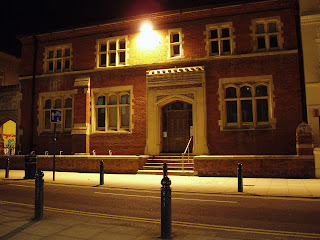
After looking at Opus 4 (walter Ruttmann, 1925), I went into town at night to take photos for an animation. Out of the photos I took, I chose to use this one first;


I was looking for interesting shapes and patterns with bright lights that created contrast. I wanted to recreatea similar sort of effect as in Opus 4 but by using existing forms rather than abstract ones.